
The Values on a Heard County Property Record
Heard County assessment records follow a statewide 40 percent assessed-value convention. A sale record answers a different question entirely. A private appraisal, in turn, is evidence prepared for a specific date and purpose.
| Value | What It Is | Where |
|---|---|---|
| Assessed value | Generally 40 percent of fair market value for tax calculation | Board of Tax Assessors digest |
| Fair market value | The assessor's full-value estimate under Georgia standards | Assessment record or annual notice |
| Sale consideration | The amount associated with a recorded transfer | Deed image or PT-61 search |
| Land and improvements | Components considered in the parcel assessment | Assessor parcel record when displayed |
When the Board of Assessors estimates a parcel's fair market value, the assessed figure generally equals 40 percent of it before exemptions and tax math. Neither number promises what a buyer would actually pay.
Understand How Heard County Estimates Fair Market Value
The Board of Tax Assessors FAQ outlines three approaches: cost, income, and sales comparison. Relevant factors include land, structures, size, age, condition, use, location, and comparable property information. Mass appraisal applies one shared method across many parcels at once. It never sees the private terms or condition behind each possible sale.
Read the 2026 Heard County Field-Review Context
A March 2026 release announced visits to every property. The visits support a tax-digest update. County representatives would drive marked vehicles, carry photo ID, photograph structure fronts and rears, note changes, and leave a door hanger if no one answered. The work updates property characteristics used in valuation. It does not touch recorded title. Before comparing an earlier property value, confirm the digest year and the notice that apply. Note: A field visit is an assessment data-collection event, not proof of a sale, deed, or boundary change.
Looking Up a Heard County Property Value
The Heard qPublic portal is the official assessor-linked starting point. The exact fields shown on a live result card vary, so confirm what the display lists before relying on any single figure.
- Search the address or exact parcel number in qPublic.
- Record the tax year, fair-market estimate, assessed value, and parcel details actually shown.
- Check the deed or PT-61 trail for a relevant recorded transfer.
- Compare dates and property descriptions before comparing the numbers.
- Assessed value
- The value used within Georgia's property-tax calculation.
- Fair market value
- The assessor's full-value estimate for the stated tax year.
- Level of assessment
- The 40 percent relationship between assessed and fair market value.
Compare a Heard County Sale With the Assessment
The GSCCCA PT-61 search lets you filter by buyer or seller name, county, date range, sale-price range, and property type. Deed records can add consideration clues. Match it to the same parcel. One sale may involve unusual terms, several tracts, related parties, or personal property. Treat it as a reference point, not a market-value answer.
Do Not Treat a Heard County Tax-Sale Amount as Value
The official 2025 tax-sale list pairs map parcels and legal descriptions with vesting-deed references, years due, and amounts due. Those delinquency totals are not appraised values. They are not ordinary sale prices either. Use the vesting book and page as a precise deed lead. Then trace redemption and any final recorded deed. The list marks one stage of the tax process, not current title or market value.
Keep Heard County Taxable Results Apart From Value
An exemption can shrink the taxable amount without moving the assessor's fair-market estimate. The Board of Assessors establishes value, while the Tax Commissioner collects the bills and handles collections. Keep those roles straight.
Fair market value: the assessor's estimate under Georgia standards. Assessed value: generally 40 percent of fair market value. Sale consideration: the amount connected to a transfer. Reassessment: an updated tax valuation.
For bills, exemptions, or appeal steps, see the Heard County property tax records guide.
Review Heard County's Published Value Guidance
The official assessor FAQ explains valuation and the 40 percent assessment framework.
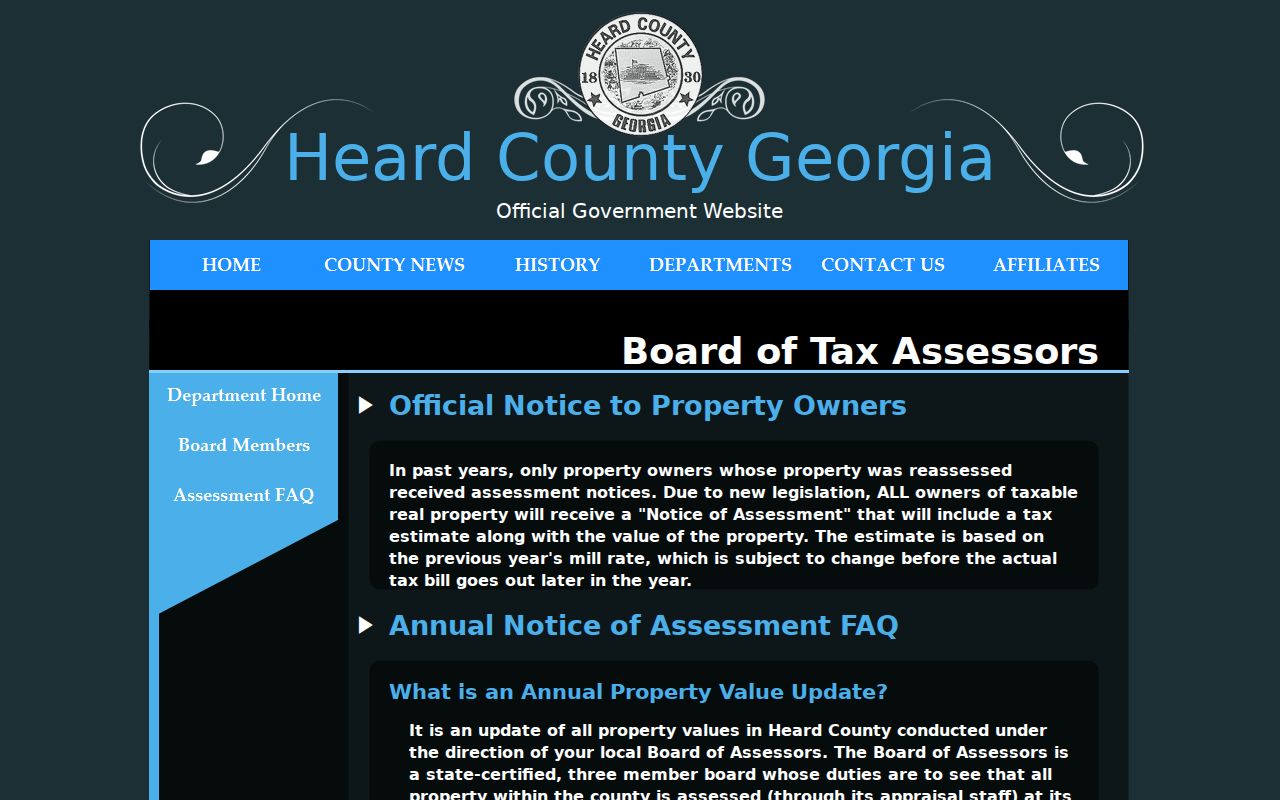
The county's published guidance slots each assessed value into its tax purpose. Reading it helps keep a sale appraisal and a tax figure from blurring together.
What a Heard County Assessor Value Is Not
The assessor's figure is a mass-appraisal result built for taxation. It can lag the market. It also misses private features and transaction terms. A licensed appraisal serves a different purpose entirely.
Value vs price. A Heard County assessed value is not a prediction of the property's sale price. Obtain a licensed appraisal when a current market opinion is needed.
Start by matching property facts. Confirm acreage, land lot and district, subdivision or tract, building characteristics, and the valuation year. A mobile-home entry, remainder tract, or one lot in a multi-parcel transfer cannot be compared with another site just because the road names match. Dates matter just as much. An annual assessment belongs to a digest cycle, while a sale carries execution and recording dates. The 2026 field review may explain a later change in characteristics even when no deed was filed. A new deed can also record before a published assessed value changes.
Review the instrument and PT-61 fields. Was it between related parties? Did it bundle several parcels, an estate, a gift, or a foreclosure? Unusual conditions deserve a label. Call the amount "recorded sale consideration" unless the source supports a firmer claim about price.
The qPublic landing page draws a clean office boundary. The assessor establishes value but does not collect taxes. The Tax Commissioner handles what was billed or due. Penalties, delinquency, exemptions, and payments can move that balance without touching fair market value. If qPublic will not open, ask the Board of Tax Assessors for the parcel record, annual notice, or valuation information for a specific year. Give the whole parcel format and the address. Do not count on an export, a comparable-sales button, or a field order, since the office supplies records on its own terms.
Label every comparison with its source. A digest, assessment notice, deed, PT-61, tax-sale list, or appraisal each measures something different, and the label says what. When a transaction or dispute turns on present market value, get an appraisal prepared for that purpose. Keep the tax year beside every figure. Later readers can then reproduce the whole comparison.