
Check the Heard County Owner-of-Record Card
The Heard County qPublic portal carries the most-current published tax digest. Each parcel card there pairs the owner name with the parcel identifier and the source date behind it.
| Owner name | Person, estate, trust, or entity carried on the digest |
|---|---|
| Mailing address | Notice destination, not proof of occupancy |
| Situs | Physical parcel location |
| Parcel number | Bridge to deed, tax, and map files |
| Legal information | Lot, land lot, district, tract, or subdivision |
| Deed reference | Lead to an instrument when displayed |
The live card does not always load, so confirm the fields it displays against your parcel. Remember, the owner of record is not always the occupant.
Measure How Current the Heard County Record Is
qPublic is a published digest, not a live closing feed. GSCCCA's Heard page indexes deed records from January 1, 1987 through September 3, 2026. A deed can be recorded last week. It can still be newer than the owner name on the tax roll.
Save three dates with every result. Keep the digest year. Keep the deed's recording date. Keep the index good-through date too. For anything newer, check with the Clerk of Court at 215 East Court Square, Room 5, Franklin. Or call (706) 675-3301.
Note: Current means current as of the source date, not that every new deed has reached every screen.
Separate Heard County Situs and Mailing Addresses
Situs is where the parcel sits. The mailing address is where notices go. The two often differ in Heard County: Centralhatchee properties can carry a Franklin 30217 mailing address, Ephesus uses Roopville 30170, and some Heard parcels show Hogansville 30230. So a postal city never proves jurisdiction.
Owner of record: the name a published record carries. Assessment roll: the tax digest. Situs: the physical location. Recording lag: the delay before a filing shows online.
Match the parcel number and legal description so the current owner stays tied to the correct land.
Verify the Present Heard County Owner Against the Deed
Use the assessor entry as the starting card and GSCCCA as the recorded-instrument check.
- Copy the qPublic owner and parcel exactly.
- Search the owner as grantee in HEARD.
- Compare the newest deed's date and legal description.
- Resolve an unindexed filing with the Clerk.
This present-tense check differs from tracing previous owners through the entire deed chain.
Confirm a Current Heard County Entity Owner
When the current owner is an LLC, keep the entity itself as the result. The Georgia business search can show status, officers, and registered agent. However, it never replaces the deed's grantee.
Trusts and estates call for exact-name searches and the relevant estate instruments. Never assign ownership to a person without a recorded basis.
Keep Heard County Field Review Separate From Ownership
A March 2026 release announced countywide digest field visits, with marked vehicles, staff ID, structure photos, and change notes. That effort updates assessment facts, nothing more.
A field visit is not a conveyance. Confirm any new current owner through the deed.
Check a Heard County Current Owner Offline
If qPublic fails, call the assessor at 201 Park Avenue, Room 300, Franklin, (706) 675-3786. Give the parcel, the street spelling, and the tax year.
For a deed, phone the Clerk at (706) 675-3301. Older evidence may sit in deed books or with Georgia Archives.
Open the Heard County Current Owner Source
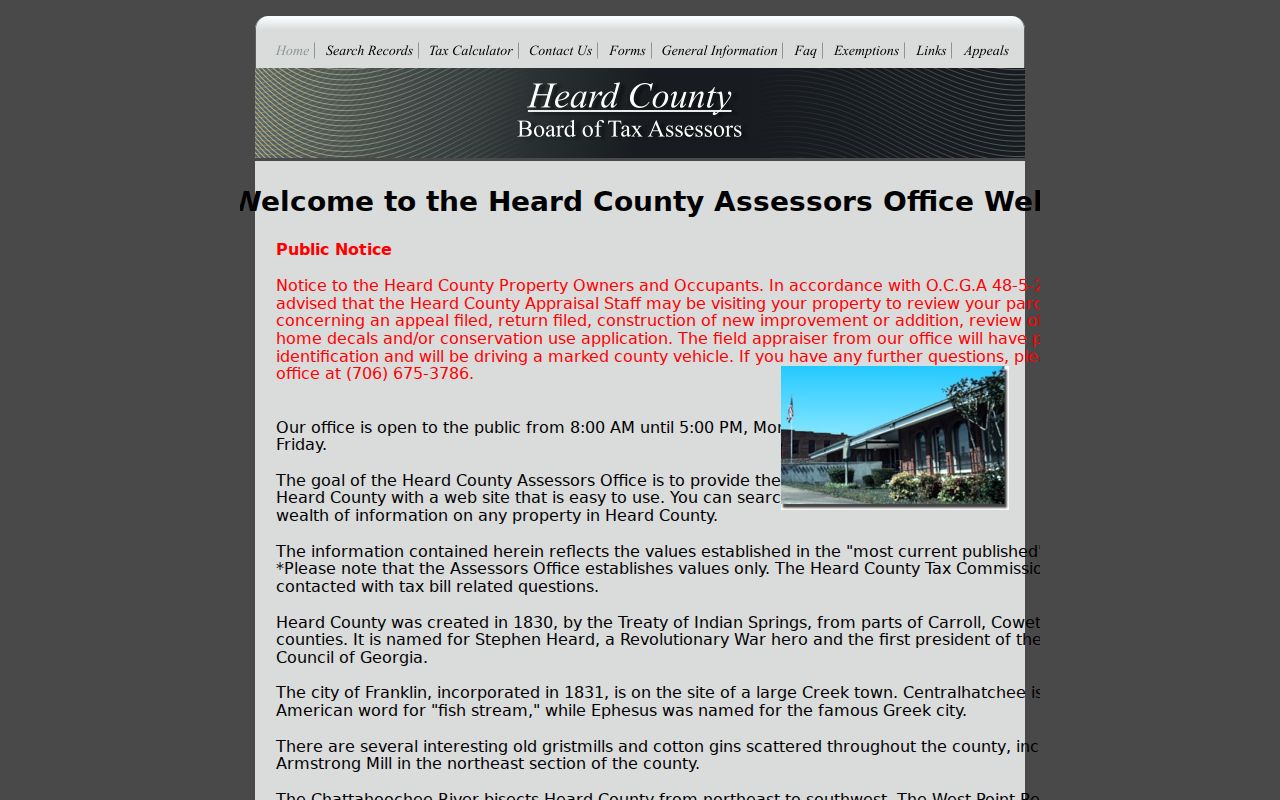
The official qPublic landing page confirms the assessor's public entry point.
A parcel card plus the newest deed remain the pair that verifies the owner of record as of a stated date.
Use Heard County Current Owner Data Lawfully
A published mailing address is a lead for property contact, not proof of occupancy, consent, boundary, or clear title. Programs like Safe at Home and VoteSafe can shield qualifying addresses.
Lawful use. Contact a Heard County owner only for a legitimate property matter. Never use a public mailing address to harass, intimidate, stalk, or harm anyone.
A solid request starts with identifiers. Give the full street address and the exact parcel number with every letter and space. Include the owner spelling as displayed and the date of the web search. Ask the assessor for the existing parcel or digest record. Ask the Clerk for the most recent recorded deed. It should be tied to the known name or book and page. If the transaction may fall after the online good-through date, say so plainly.
The 2025 tax-sale list shows why identifiers matter. Heard parcel formats include lettered map sections and trailing segments. A single property can carry several vesting-deed references. Preserve those clues instead of reducing the check to a mailing name. Land lot, district, tract, subdivision, acreage, and life-estate wording can separate results that otherwise look alike.
Conflicts between the roll and the deed deserve a slow look. Compare dates before choosing an answer. Establish the digest year and the deed index cutoff. Then inspect the deed itself for the grantee and legal description. An older tax entry can be accurate for that digest yet stale after a transfer. An index row without its image may cover only part of a parcel or a limited interest.
Office duties also explain apparent conflicts. The Board of Tax Assessors maintains digest values and parcel information. The Tax Commissioner handles bills and collection. The Clerk records conveyances. A paid tax bill or value notice is not proof of the current owner. For a disputed title, obtain certified instruments and qualified help.
Names need disciplined handling too. Search an individual with last name and first name variants. Then test initials if the exact form fails. For an entity, preserve punctuation and try the complete legal name shown on the assessment record. GSCCCA permits selection by grantor, grantee, or all parties. The current owner should first be tested as a grantee. Narrow by instrument only after a broad search shows the available record families.
Copy both dates on the deed. The recording date is the useful index date, while the execution date may be earlier. Note whether the latest instrument is a warranty deed, quitclaim deed, deed from estate, gift deed, or another type. The label helps explain how the present interest was conveyed. It does not replace reading the image. Compare the legal description against the parcel, especially if the deed describes a remainder, tract, or land-lot portion.
If online access stays blocked, a focused Georgia Open Records request may seek an existing address assignment or parcel record. It may also seek a map or zoning file. State the parcel and a narrow date range. The law does not require Heard County staff to create a new ownership report. Ask the correct custodian for the existing record. Allow for lawful redactions, retrieval fees, or a response describing when the material can be produced.