
How Heard County Property Tax Records Divide the Facts
Heard County splits appraisal and collection. The Heard County Board of Tax Assessors maintains the valuation side of the property tax records, and the Tax Commissioner handles every bill and payment. A value question belongs with the appraisers.
| Tax-record field | Meaning | Responsible office |
|---|---|---|
| Fair market value | The appraiser's estimate before the statutory assessment percentage | Board of Tax Assessors |
| Assessed value | Generally 40% of fair market value under Georgia's convention | Board of Tax Assessors |
| Exemptions | Approved reductions or classifications applied to the assessment | Board of Tax Assessors |
| Bill and balance | Tax charged, payments, and amount due | Tax Commissioner |
| Delinquency or sale stage | Unpaid years and levy or sale information when applicable | Tax Commissioner |
The assessor FAQ explains the annual notice. It also covers the methods the office uses to value property. A bill is not a sale price. It grows out of the taxable assessment and the levies applied to it. For proof of ownership, the recorded deed is the controlling document. The property tax record is not.
qPublic Opens the Heard Assessment Record
Heard County posts its assessment data through the qPublic assessor landing page, which opens the live Schneider search. The public database mirrors the most-current published tax digest. Appraisal stays separate from collection there. Search branches cover owner, location address, parcel number, and legal information.
| Search branch | Input | Best use |
|---|---|---|
| Owner | Owner Name; Exact name match | Find parcels under a known person or entity spelling |
| Location | Address or Range; Exact match | Start from a street or numbered range |
| Parcel | Parcel Number | Retrieve an appraisal with a known map key |
| Legal | Legal Information | Test a subdivision or description clue |
The Schneider result screen carries the fields and export options available for each parcel lookup. The qPublic landing page is the access point.
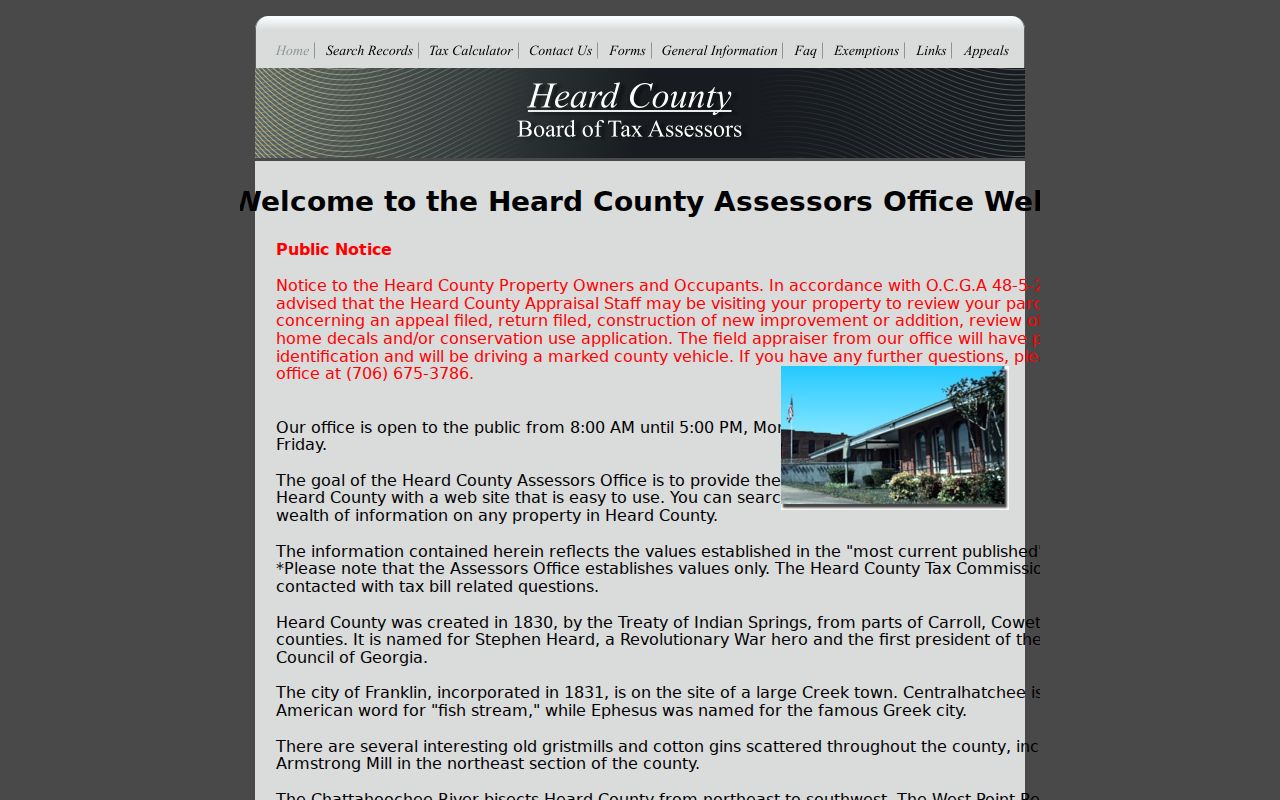
Treat each result as an assessment source. Note the digest year. Payment receipts and current balances come from the Tax Commissioner, not the digest.
Note: qPublic's published digest is an appraisal record, not a live statement of the tax balance due.
Read Heard's 40 Percent Assessment Correctly
Georgia law generally assesses property at 40% of fair market value. The assessed figure is not a price. Fair market value is the assessor's estimate of worth. Assessed value is the statutory slice that exemptions and levies act on. Comparing an assessed number straight against a purchase price misreads both measures.
- Fair market value
- The appraisal estimate under the county valuation process.
- Assessed value
- Generally 40% of fair market value.
- Homestead exemption
- Tax relief requiring eligibility and application.
- Millage or levy
- The rate used by taxing authorities in the calculation.
- Tax lien
- A claim arising from unpaid taxes that requires a current status check.
Comparable sales, land characteristics, buildings, and other verified factors can support an appraisal. A deed consideration or a PT-61 transfer shows history. Neither one automatically dictates the assessor's present fair market value.
The 2026 Heard Field Review Updates Digest Data
The Heard County assessor announced a countywide field review of the tax digest. The start date is March 12, 2026. Representatives plan to visit every property. The notice describes marked county vehicles, photo identification, and door hangers. Staff photograph the front and rear of each structure and note changes since the prior review. The work feeds the digest. It transfers no title.
The assessor sits at 201 Park Avenue, Room 206, Franklin. Confirm the active schedule there. Review notes, photographs, annual notices, and later corrections can explain why one year's property tax record differs from another. Nonexempt documents can also be requested through Heard County's Open Records form.
Note: Verify a visitor through the assessor office; a field review affects appraisal data and does not change the deed.
Look Up a Heard County Tax Bill in Two Stages
Heard County's official payment landing page presents the Property Taxes option. It also names the Tax Commissioner behind the bills. The bill screen is stage two, where a parcel lookup opens the amount due. Keep a parcel number handy.
- Find the parcel and appraisal year through qPublic, preserving spaces and letters in the parcel number.
- Open Property Taxes at the payment landing and complete the access check.
- Match the account to the parcel and tax year before reading a balance or payment status.
- Compare exemptions with the assessor record and ask the Tax Commissioner about delinquency or sale stage.
The captured CAPTCHA explains why a saved link may not reach a bill.
The Tax Commissioner sits in Room 300, 201 Park Avenue, Franklin. Call (706) 675-3391 or email heardtc@heardcountyga.com. Bring the parcel, address, owner of record, and tax year.
A Heard Tax-Sale Row Is a Lead, Not a Deed
A tax-sale row is only a lead. The county's revised 2025 tax-sale list pairs a map parcel and postal address with the legal description. It also lists the vesting deed book and page, years due, and amount due for every delinquent entry. Parcel strings like 0056A 0038 show why spaces and letter suffixes must be retained.
Start from the parcel. Pull the book and page through GSCCCA. Check current appraisal data. Ask the Tax Commissioner whether the amount or sale status changed. Then follow any redemption, cancellation, or final deed recorded later.
Do not treat a tax-sale list as title. It is a dated delinquency snapshot. Confirm redemption, balance, and later recorded instruments before drawing an ownership conclusion.
Heard Homestead Questions Start with the Assessor
The Georgia DOR Heard facts page covers the local calendar, returns, homestead, mobile homes, and freeport matters. The county assessor page adds an HB 92 homestead note. Eligibility and filing rules shift over time. Use the form and deadline supplied for your year.
Never assume an exemption survives an ownership, occupancy, or classification change. Ask the assessor which application and evidence apply. Keep the confirmation and annual notice. Then check how the approved treatment shows up on the Tax Commissioner's bill.
Respond to a Heard County Assessment Notice
The annual notice starts the appeal clock. The assessor's office publishes an annual-notice explanation and an invitation to discuss valuation, but no fixed calendar date. Read the current notice, contact the Board of Tax Assessors promptly, and file through your chosen appeal route by the printed deadline.
Good support includes comparable properties, corrected characteristics, photographs, a survey, permit history, and a precise account of the error. Keep a valuation dispute separate from a payment question. The appraisers and the appeal process handle value. The Tax Commissioner administers the bill.
The notice controls the appeal window. File with the Heard County Board of Tax Assessors by the deadline printed on the annual notice, verify receipt, and retain a complete copy.
Reach the Right Heard County Tax Desk
Two offices split the Heard County tax work. The qPublic portal and the Board of Tax Assessors handle parcel identification, characteristics, valuation notices, exemptions, and appeals. The Tax Commissioner handles bills, receipts, amounts due, collection status, and tax sales. Call the assessor at (706) 675-3786. Reach the Tax Commissioner at (706) 675-3391 or heardtc@heardcountyga.com. Both sit inside the county administration complex at 201 Park Avenue in Franklin, in Rooms 206 and 300. An August 2026 notice announced that the Tax Commissioner office would stay open through lunch starting September 1, 2026. Hours shift, though. So call before making a special trip.
Put your question in writing clearly. Identify the parcel exactly and state the tax year. Say whether you need appraisal help or collection help. State whether a plain copy or an official response will do. Georgia's Open Records Act offers another path to an existing nonexempt record the public portal does not show. The Attorney General's guidance describes a response within three business days. That guidance also notes that an agency need not build a new report. So ask for an identifiable document rather than an open-ended investigation. A named year's assessment notice, field-review record, tax bill, receipt, or sale notice all work.
Keep a Year-by-Year Heard Tax Workpaper
A good Heard County tax workpaper keeps each year on one clean line. Blend nothing. For every parcel, record the exact parcel number and the fair market value. Add the assessed value, exemptions, notice date, and appeal status. Also record the bill amount, payment status, and the source date. Values and exemptions move for different reasons. A late payment changes the balance without touching either figure.
Before comparing years, confirm the parcel itself did not split. Make sure it did not combine or gain a new suffix. Then compare the land and improvement components side by side. Look for a field review or permit event that could explain a jump. The 2026 countywide review matters for current comparisons. Do not project it backward onto years whose records never mention it.
A purchase inquiry calls for a different check. Weigh the latest published digest against the current bill. Then ask whether any unposted change, appeal, delinquency, or sale action is still pending. For an appeal, keep the exact notice. Keep every piece of evidence sent before the deadline too. For historical research, treat tax digests as proof of valuation and tax responsibility, not as conveyances. Georgia Archives microfilm can carry a tax-history question into older Heard digests. The deed books remain the ownership trail.
The workpaper also routes conflicts to the right desk. Appraisal errors belong to the Board of Tax Assessors. Collection errors go to the Tax Commissioner. A dispute over who acquired the land lands with the Clerk's recorded instruments.