
What Heard County Deed Records Carry Forward
The Clerk of Superior Court keeps the conveyance trail alive in Heard County. Every deed, easement, lien, cancellation, or restrictive covenant leaves a mark there. Some instruments transfer ownership outright. Others affect the same parcel without conveying it. So the type matters as much as the filing. The Georgia Superior Court Clerks' Cooperative Authority real-property system pulls index and image data from county clerks into one place. Read the instrument itself, never just the index label.
| Deed Type | What It Does | Common Use |
|---|---|---|
| Warranty deed | Conveys the stated interest with title covenants written into the instrument | An arm's-length land transfer |
| Quitclaim deed | Conveys whatever interest the grantor has without promising its extent | Correcting or clarifying an ownership interest |
| Deed of gift | Transfers property without a conventional sale consideration | A family or donative transfer |
| Estate or executor deed | Documents a conveyance made under estate authority | Moving land from an estate to a buyer or beneficiary |
| Foreclosure or tax deed | Records a transfer arising from the applicable sale process | Following distressed-property title after the sale stage |
Georgia leans on the security deed for most real-estate financing. That instrument belongs in the recorded trail, yet it records a loan, not a purchase. The owner's acquisition deed is a separate event entirely. A thorough Heard County deed search reaches past both. Look for assignments, cancellations, liens, releases, boundary agreements, easements, and estate papers. These explain later entries in the property records.
Heard's Online Deed Index Starts in 1987
The county-specific GSCCCA good-through report lists Heard County coverage beginning January 1, 1987. Its good-through date is September 3, 2026 at 11:59 p.m. The report also shows a four-day transmission lag. That gap is a practical warning. A newly delivered deed may not appear in the online index right away. When an exact recording date matters, call the Clerk and recheck the report before relying on it.
The electronic cutoff is not where Heard County land ownership begins. It simply marks the start of this online index span. A pre-1987 chain of title takes more digging. Find the last grantor online, and take that name into the clerk's reverse and direct indexes. From there, work backward through the deed books themselves. Note each book, page, and instrument date before stepping back another generation. The Heard good-through screen provides the county-specific coverage evidence for the parcel search.
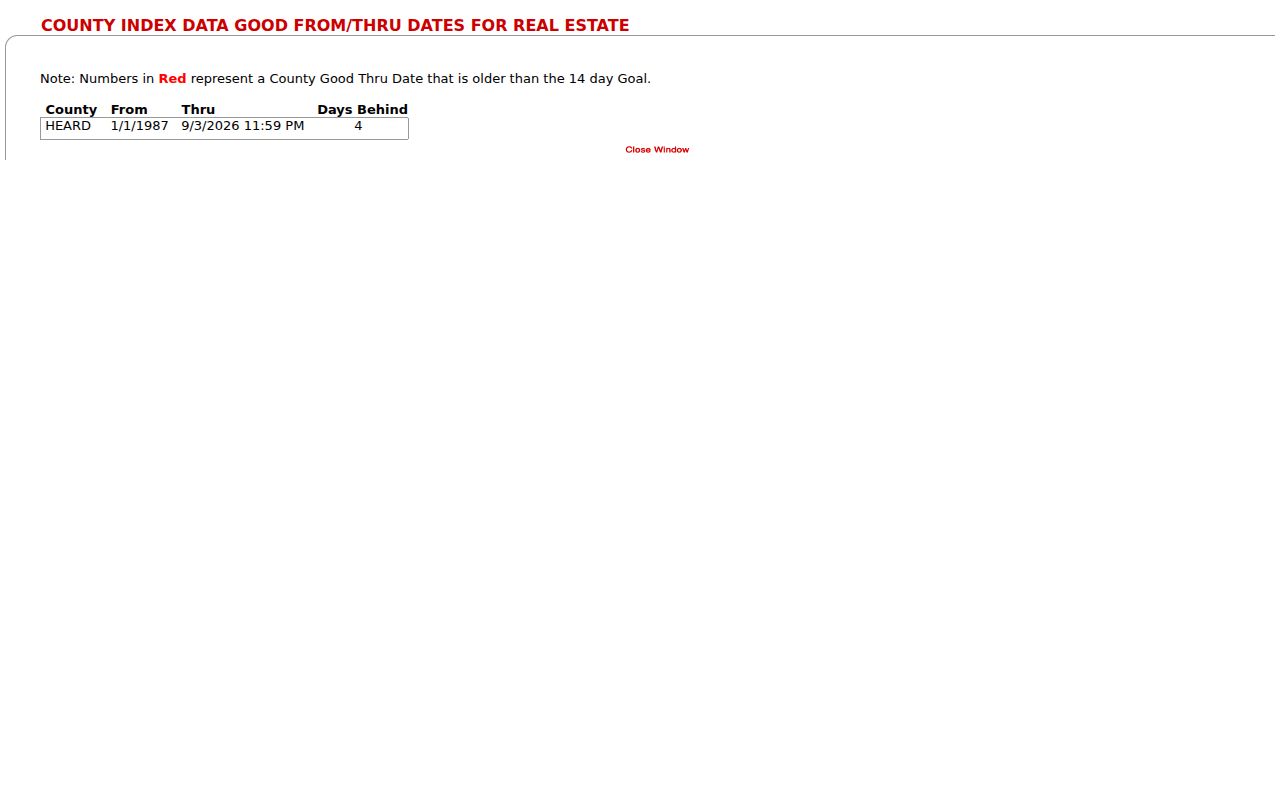
Read the beginning and good-through values together. Recheck both whenever a recently filed instrument is in play.
Note: A missing online entry before 1987 calls for a book-index search, not a conclusion that no deed existed.
Search GSCCCA by Party, Instrument, and Date
Start with the GSCCCA real-estate name search. It gives a broad sweep of party names in Heard County. The index covers every instrument the recorder files. Try both party roles. A buyer in one deed may appear as a seller in another. Add date limits only after you know the recording window falls inside the online span. Initials, entity suffixes, punctuation, and married names can scatter one person's entries across several results. Run a few spellings before concluding anything.
| Search control | Available choice | How to use it |
|---|---|---|
| Party Type | All Parties, Grantor, Grantee | Use grantee for an acquisition and grantor for a later conveyance |
| Instrument Type | All Instruments or a named class | Start broad, then isolate deeds, easements, liens, or cancellations |
| Name | Last/entity and first name fields with search mode | Try a controlled spelling variant rather than assuming no match |
| County | HEARD | Prevents same-name instruments from other Georgia counties entering the set |
| Date range | Begin and end recording dates | Use recording date, which can differ from the instrument date |
A book and page citation shortens the work. The book/page search takes county, book, and page and jumps straight to the recorded deed. GSCCCA also runs a PT-61 buyer/seller search. It keeps a separate plat index too. Each tool covers a different angle on the deed records, so treat them as complements rather than a complete title file.
Two Views of the Heard County Recorder Search
The official name-search screen shows the criteria available before a result is returned.
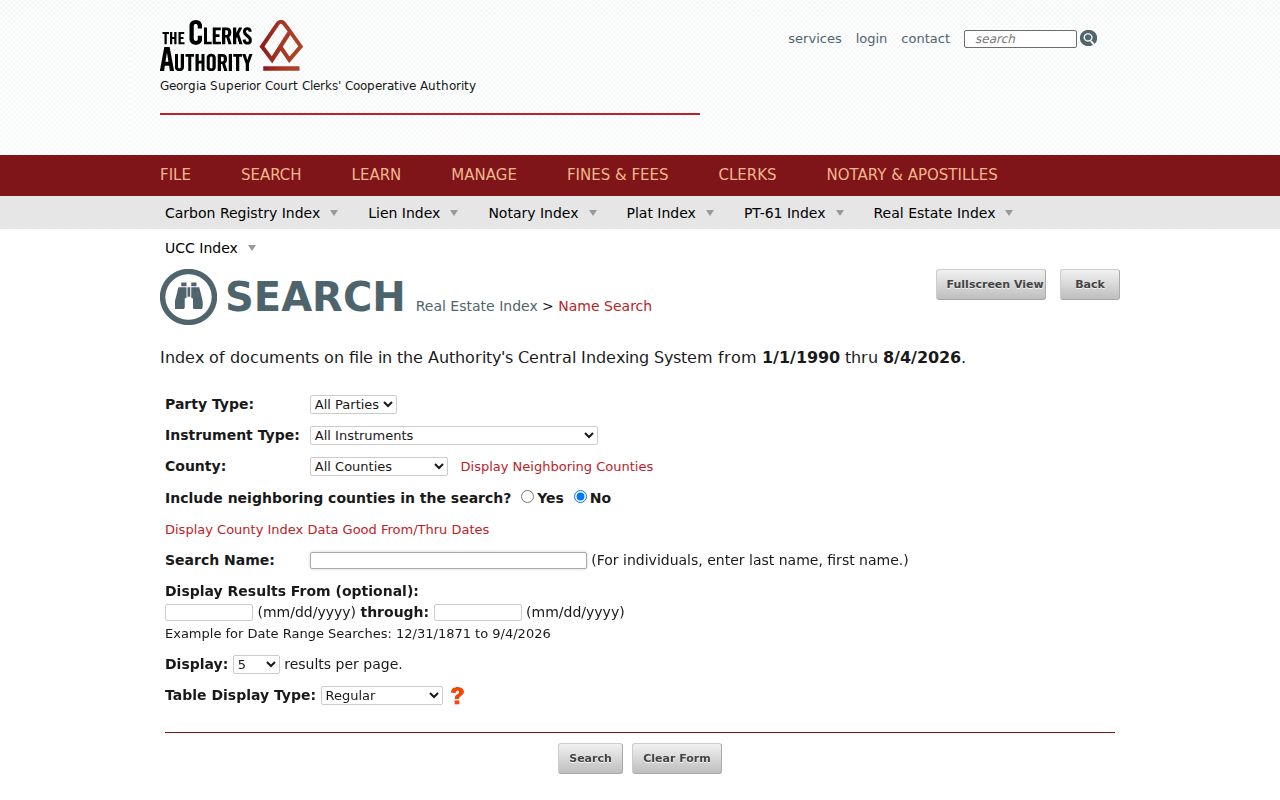
The form shows the search interface itself. It proves no deed and no chain of title. Once you have a reference, cite it precisely through the GSCCCA book and page form, which returns the exact recorded page.
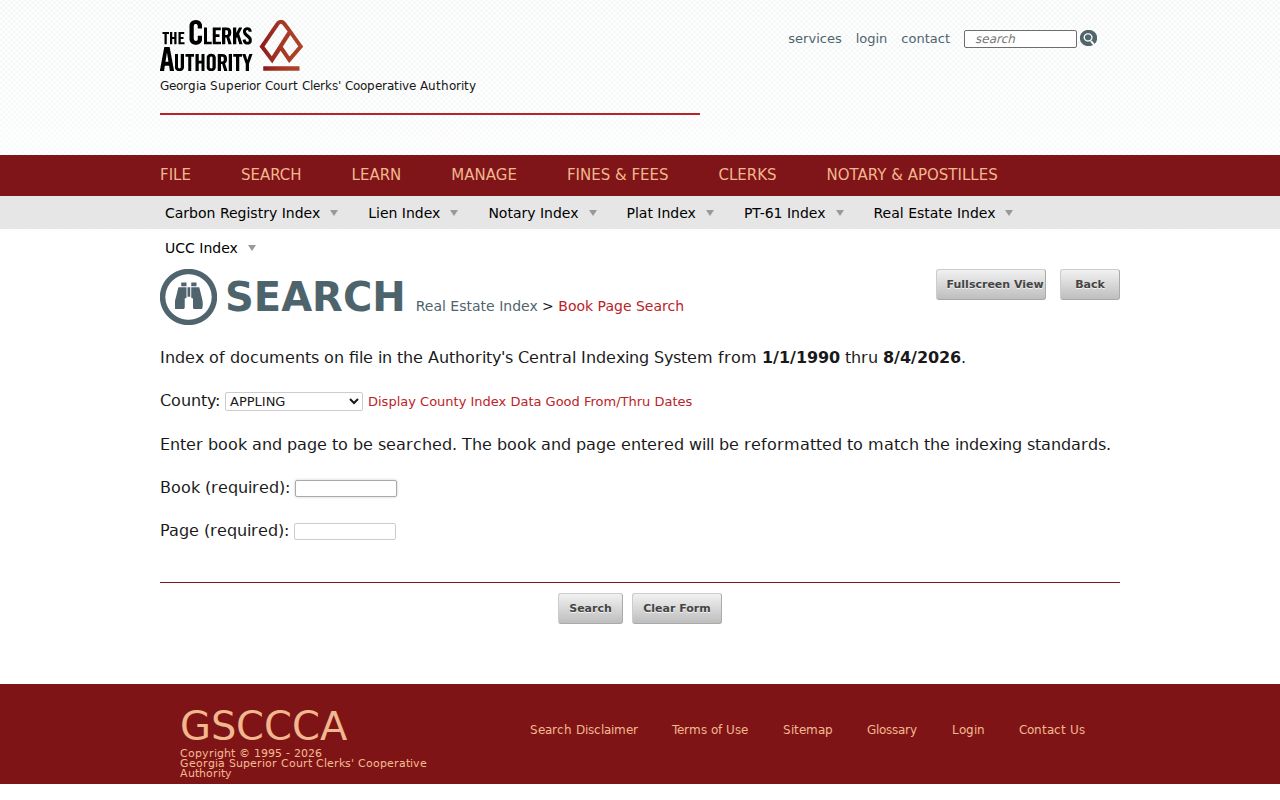
The second view pays off when a plat, tax-sale list, prior deed, or clerk's reply already gives you a book and page. Enter the numbers and the county together. Keep the county attached to the citation, because an identically numbered book in another county's deed records could otherwise be mistaken for Heard County.
Follow Heard County's Grantor-Grantee Trail
A chain of title in Heard County comes together one recorded deed at a time. Start from a document you can already tie to the parcel. A solid book and page reference beats a name-only hit every time. A matching legal description works just as well. Once anchored, read the grantor, the grantee, the recording reference, and the property description as a single set of facts. Then chase the next transfer in the deed records.
- Find the acquisition instrument with the current owner or entity shown as grantee, and verify the parcel description.
- Read the grantor from that instrument and note the recording date, instrument type, and book/page.
- Search that grantor in the earlier grantee role to locate the deed by which the grantor acquired the same tract.
- Repeat while the legal description continues to match; move to clerk indexes and deed books when the chain crosses 1987.
- Grantor
- The party shown transferring the stated interest.
- Grantee
- The party shown receiving that interest.
- Chain of title
- The connected sequence of conveyances affecting the same land.
- Book/page and instrument number
- Recording references used to identify a filed document; capture whichever reference the index supplies.
A shared surname does not prove two Heard County deeds describe the same land. The reliable bridge is the parcel detail: acreage, subdivision, land lot, district, road frontage, adjoining owners, and recitals of prior deeds. Estate transfers and entity name changes can break a clean seller-to-buyer pattern, so pull the instrument image from the deed records and read the whole document before drawing conclusions.
Before GSCCCA, Use Deed Books and County Microfilm
Heard County was created in 1830 from Carroll, Coweta, and Troup counties. That matters for old parcels. A tract history predating the county can lead back into a parent county's deed records. It can also point to Georgia land grants or lottery material. The Georgia Archives county-card finding aid shows which Heard County holdings actually survive. That beats assuming every series or date is complete. The Archives' microfilm program covers Heard tax digests and Superior Court deed books. It also includes probate or ordinary material, with historical records generally running through about 1900 and sometimes later. Under its retention schedule, deed books and their indexes are permanent records. The entries carry grantor, grantee, instrument date, recording date, and volume and page data. For certified copies of current deed records, the Clerk remains the custodian of record. The Archives and local history collections fill in older access and context. Old descriptions rarely use a modern street address. Land lot and district do the work instead. Creek-derived names like Hillabahatchee, Wehutkee or Whitewater, Yellow Dirt, and Nutt Creek can rescue a search. Try them when a road name fails.
The 1893 Courthouse Fire Is a Search Clue, Not a Verdict
Heard County's courthouse burned in 1893. A replacement opened the next year. The current courthouse replaced that building in 1964. That succession explains why older references to Heard County property records may point to different buildings or later custodians. No detailed disaster-loss inventory survives. So treat the fire as a clue, not a verdict. A missing deed is not automatically a destroyed deed.
The Heard Historical Society keeps a museum and archive in the Old Jail, with photographs, newspapers, historic community names, and local context. It is not the recorder and cannot certify title. Use the society to develop a lead, then confirm it in a deed book, clerk index, plat, probate file, or Archives holding.
Note: Document the book or series actually checked before attributing any gap to the 1893 courthouse fire.
FANS Watches Future Heard County Filings
GSCCCA's Filing Activity Notification System, called FANS, lets a registered user set name-based alerts for future real-property filings in Heard County. It watches for new filings, not ownership. It never substitutes for reading the recorded instrument itself. The FANS sign-in page makes the login requirement plain. Common-name alerts can return unrelated matches, and coverage depends on what the clerk transmits to the system.
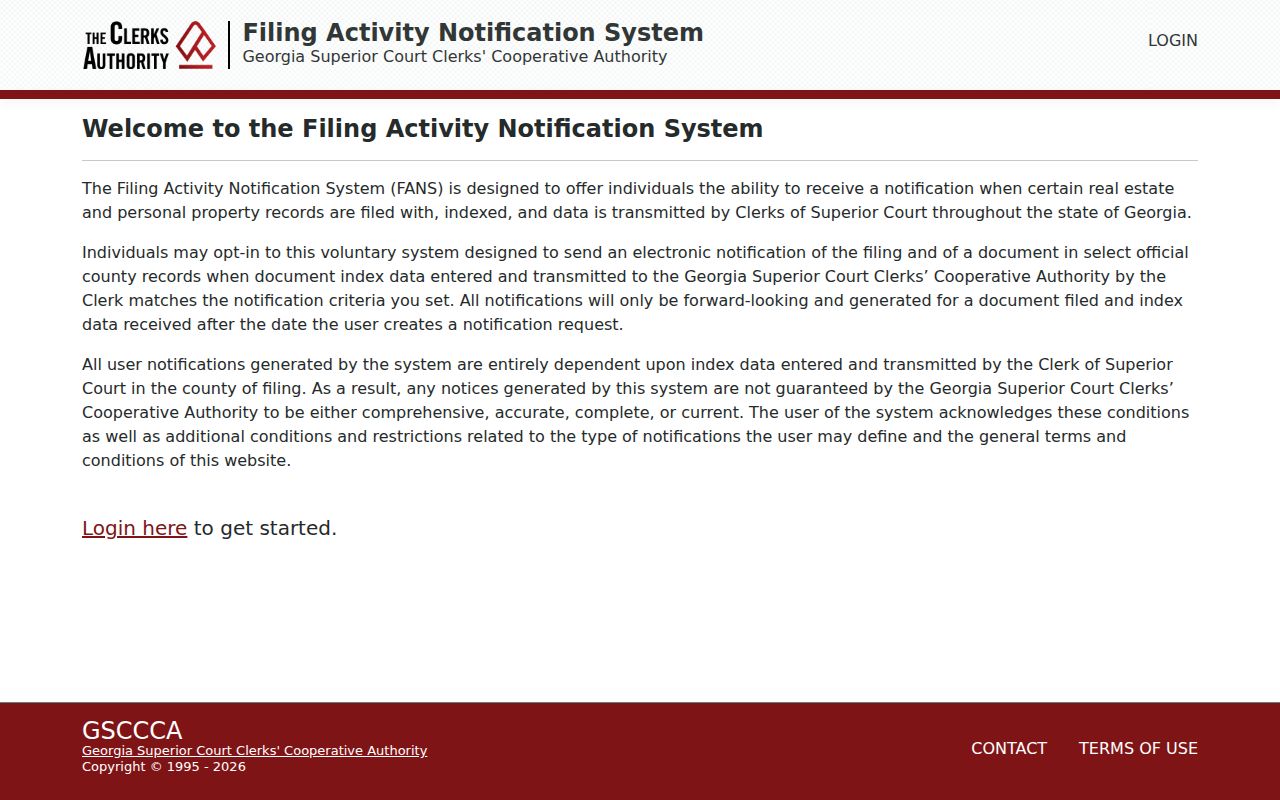
Treat any alert as a prompt, not proof. A notification alone establishes neither fraud, ownership, nor a document's legal effect, so open the index entry and the image before drawing any conclusion.
Request a Heard County Deed Image or Certified Copy
For an online index or a downloadable image, GSCCCA is the place to start. Turn to the Clerk of Superior Court when you need a certified copy, an older book, or a newly recorded instrument. The office sits at 215 East Court Square, Room 5, Franklin, Georgia 30217, and can be reached at (706) 675-3301 or tteal@heardcountyga.com. Call before mailing a request so you can confirm the reference, the current charge, the payment method, and how copies come back. The county publishes no copy-fee schedule, so asking ahead saves a round trip.
A strong request includes both party names, the approximate recording date, the instrument type, the book/page or instrument number, and the property description. If the online service is down, the clerk counter, telephone, email, and written requests all work. Nonexempt records can also be requested through Heard County's Open Records form. Under the Georgia Open Records Act, the agency generally responds within three business days, though it need not create a new record.
Recorded is not a title opinion. The index reports what the Clerk received and indexed. Unrecorded interests, indexing errors, later instruments, or legal disputes may exist, so a transaction-level title question needs qualified review of the complete chain.
Build a Citation That Survives a Same-Name Match
A deed citation needs more than party names. Capture the instrument type, execution date, and recording date. Add the deed book and page or instrument number, the legal description, and the image or certification status. An index hit is only a lead. Label it as one. Reading the actual instrument keeps a similar name or an unrelated parcel out of the title chain.
Compare descriptions across consecutive instruments. Tract and subdivision names such as Cooksville Farms, Wesley Woods, and Tuscan Hills appear across Heard County records. So do land lot, district, acreage, road, and prior-deed references. Do not lean on the postal city. Heard County deed records can carry Hogansville, Roopville, or Franklin mailing geography without settling municipal limits. The parcel number and the recorded description form the stronger bridge.
Estates need special care. Identify the actual authority for a conveyance instead of assuming the executor label explains itself. Security deeds demand the same discipline. Follow assignments and cancellations without treating the lender's interest as an ordinary owner transfer. When a split, combination, new survey, or subdivision changes the description, locate the plat and document how the old tract became the new parcel.
Know when to stop. The search ends when the instrument is identified, the source and as-of date are recorded, the image or certified-copy need is clear, and open title questions go to the right professional or custodian. Name-only searching past that point just adds noise.