
Tracing Former Owners of a Heard County Property
Treat the deed-chain table as a worksheet. Add a row only after the instrument or index supplies its grantor, grantee, type, date, and reference.
| Source | Years It Covers | Where Held | What It Shows |
|---|---|---|---|
| GSCCCA real-estate index | 1987 to current good-through date | Online and Superior Court Clerk | Grantors, grantees, instruments, and recording references |
| Deed books and indexes | Before online coverage; exact first volume unverified | Superior Court Clerk and Archives microfilm | Earlier conveyances and legal descriptions |
| Recorded plats | Coverage varies by volume | GSCCCA plat search and Clerk | Subdivision, lot, road, and easement context |
| Historic tax digests | Surviving years shown by finding aid | Georgia Archives | Tax responsibility and land clues by year |
The GSCCCA name index starts the modern chain of Heard County deeds. For the earlier route, turn to the Clerk and the Georgia Archives, which hold the older Heard County records.
Go Back Through Heard County's 1987 Online Cutoff
Online indexing has a firm start date. The county's real-estate index coverage begins January 1, 1987, and that cutoff marks the edge of the digital window rather than the birth of Heard County deeds. Older conveyances wait in the deed books.
Time-depth limit. Previous owners before 1987 may require deed books, index volumes, microfilm, and direct Clerk or Archives work.
Record the good-through date because GSCCCA transmission can lag the Clerk's current filings.
Search Heard County Grantors and Grantees in Reverse
GSCCCA filters by Party Type, Instrument Type, County, Search Name, and date range. Select HEARD, begin with the known current grantee, and run initials, estates, trusts, and entity punctuation as separate searches.
| Index field | Backward-chain use |
|---|---|
| Party Type | Find a person first as grantee, then as grantor |
| Instrument Type | Separate warranty, quitclaim, estate, gift, or foreclosure deeds |
| Date range | Bracket the ownership period |
| Book/Page | Return to the precise recorded volume |
Compare the legal description before adding any name match.
Walking the Heard County Deed Chain Backward
Each prior owner becomes the search key for the preceding transfer. Work one deed at a time. Keep execution and recording dates separate throughout.
- Find the current owner's acquisition deed with that owner as grantee.
- Read the grantor and legal description from the image.
- Search that grantor as an earlier grantee and compare the land.
- Repeat to 1987, then move to deed-book indexes.
- Grantor / grantee
- The conveying party and receiving party named in a deed.
- Chain of title
- The ordered sequence of recorded interests affecting the same land.
- Legal description
- The land-lot, district, tract, acreage, or plat language that survives address changes.
Follow Heard County Land Lots, Tracts, and Plats
Addresses can change while land descriptions persist. The 2025 tax-sale sample pairs parcel 0056A 0038 with Tract 17, Land Lot 187, District 3, and 3.80 acres, while another row points from Cooksville Farms to plat book 9, page 266. Search one distinctive token at a time. Preserve every parcel letter, space, and suffix in the identifier.
Reconstruct Heard County Estate Transfers
Sale-to-sale chains sometimes break. Title can move through probate, a life estate, or other estate paperwork instead. One official tax-sale row labels a life estate and cites three deeds, a lead worth inspecting rather than proof of every interest.
A grantor conveys and a grantee receives. A reverse index organizes entries by grantee, while a quitclaim deed transfers only the interest the grantor holds.
Place Heard County Owners Across Courthouse Eras
Heard County formed in 1830 from Carroll, Coweta, and Troup. The courthouse burned in 1893. A replacement opened in 1894. The current courthouse followed in 1964. No exact loss inventory exists. Do not assume every earlier deed vanished. Archives county cards identify surviving microfilm. The Historical Society adds place-name context. Each former owner still needs confirmation in a deed or tax record.
Inspect the Heard County Former-Owner Search Form
The official GSCCCA name-search form supplies the grantor, grantee, instrument, county, and date controls. The backward chain runs on those fields.
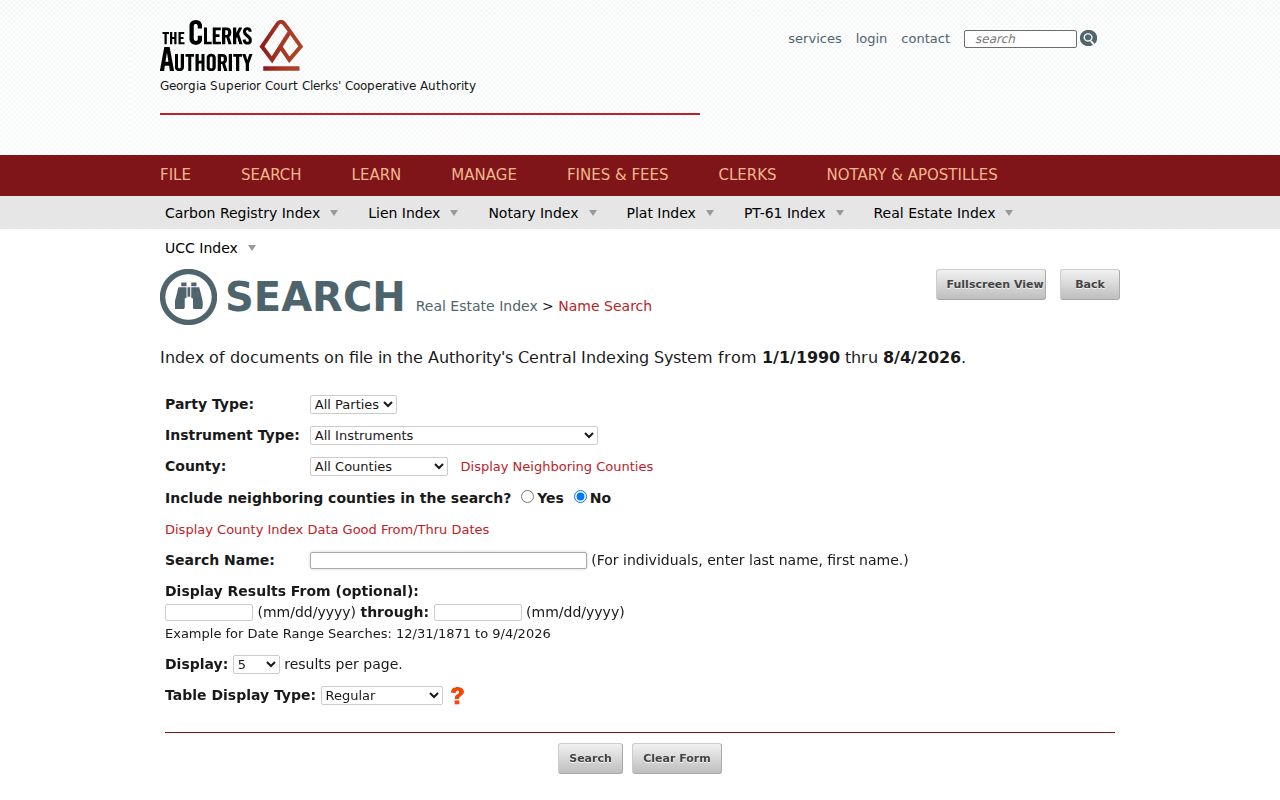
Fields organize the hunt. The deed image and matching legal description decide whether a result belongs in the chain.
How Far Back Heard County Ownership Records Go
Heard County deeds begin in 1830. Earlier land history sits in Carroll, Coweta, Troup, and Georgia land-grant or lottery sources, and the Georgia Archives county cards point to surviving deed, tax, and probate microfilm. A directory or museum caption can suggest a name. It cannot substitute for a conveyance. Stop when every previous owner ties to a cited instrument and every gap carries a label.
Lawful use. Former-owner research supports house history, title work, and property diligence. Never use these records to track, harass, intimidate, or harm a living person.
A chain worksheet should record the execution date, recording date, and instrument label. It should also list parties, book and page, and legal description. Add the source for every row. Say whether you saw an image or a certified copy. That discipline keeps an index clue from hardening into an unsupported ownership claim.
Parcel changes need their own notation. A split or combination can hide the current parcel number from an older deed. Letter suffixes and mobile-home entries do the same. Follow land lot, district, tract, acreage, subdivision, and plat references instead. The Heard tax-sale sample shows both lettered identifiers and multiple vesting references.
Historic place names can reopen a stalled chain. County history preserves Centralhatchee, Hillabatchee, Wehutkee or Whitewater, Puchusehatchee or Yellow Dirt, and Nutt Creek. Try those terms in historic maps and indexes. Still confirm the former owner in a deed, tax digest, or plat. A probate file or land-lottery source works as well.
Probate can explain a stretch with no purchase deed. Search estate documentation and later deeds signed by an executor or heir. A life estate splits present possession from a remainder interest. Do not flatten those roles into one former owner unless the instrument establishes them.
Before 1830, the parent county owns the timeline. Search Carroll, Coweta, and Troup as the tract's location requires. Then bridge forward into Heard County records. Land-lottery and grant files may identify a parcel by lot and district. You may see a lot and district rather than a road. Record the county beside each date so an apparent gap explains itself.
The Georgia Archives retention schedule treats deed books and deed indexes as permanent records. Permanent status preserves grantor, grantee, instrument, instrument date, volume and page, and recording date. Use the county-card finding aid to learn which Heard volumes survive. Do that before an archive visit or mail request. Report a confirmed span only.